Drones & UAV Systems: Building Intelligent Autonomous Drone Solutions with PX4 and ROS 2
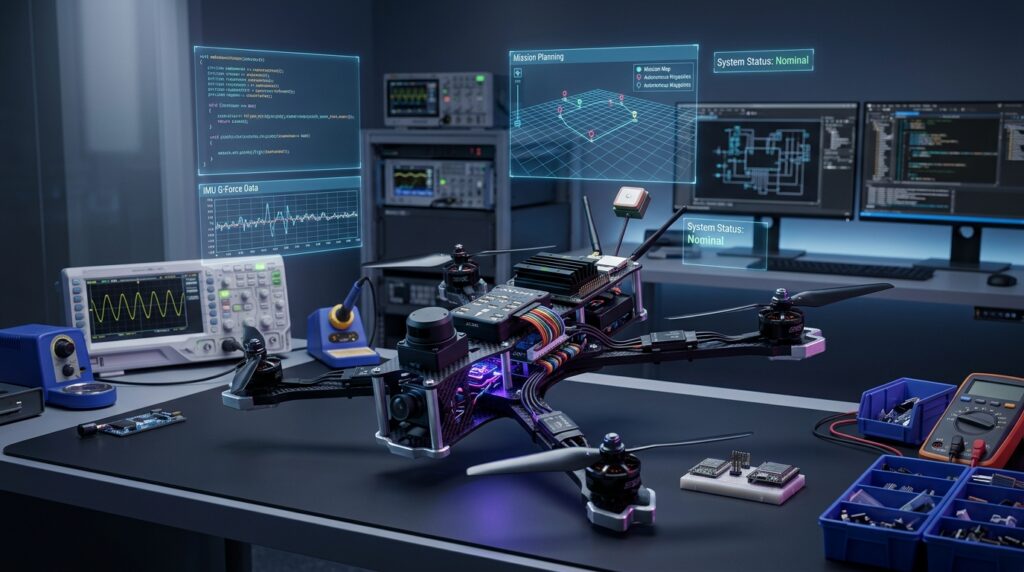
The development of Drones & UAV systems has completely changed industries by giving them the facility of rapid data collection, self-guided inspections, aerial mapping surveillance precision agriculture, and emergency response. As autonomous technologies progress further, Plainly pairing PX4 with ROS 2 is an extremely capable solution for the development of smart, large-scale, and trustworthy drone applications. Beside the powerful combination of these open-source platforms, developers have full freedom in designing UAVs that they can navigate autonomously, avoid obstacles, do mission planning, real-time decision making etc. Mechanical parts like motor propeller etc. and the electric system (e.g. LiPo battery) that powers the UAV make up the mechanical component part; while the flight controller, navigation system sensors etc. constitute the electronic part; finally, the software part mainly consists of the flight software, mission software, and other supporting software programs. On the ground part side, apart from ground communication equipment, there are also other ground-based equipment and facilities, e.g. battery charger, spare parts tools etc. used for servicing a drone, ground remote control equipment, data acquisition, storage, and display equipment, etc.
Flight controllers, GPS modules IMUs LiDAR cameras ultrasonic sensors, and wireless communication systems help a drone to understand its surroundings by getting data about the environment, so that it is safe, accurate, and precise to use a drone. Among all the components in the hardware side, the flight controller is one of the critical components. The PX4 is the open-source flight controller which has become quite popular and is a part of The Drone Code project. Besides the PX4, we recommend the user to use any compatible companion computer such like ODROID, NVIDIA Jetson, etc. which will run all the software and handle hardware and communication interfaces. This way, if a sensor is added or removed after the drone assembly, the main part responsible for the sensor (software part on the companion computer) can be reconfigured easily and the flight controller software (PX4 part) need not be touched at all.
While PX4 takes a flight control role, ROS 2 is the source of the capability of a drone that enables it to perform autonomous operations. It brings communication interface between various parts like sensors, computers and navigation algorithms, all the while keeping things modular. This opens possibilities for developers to include things such as object detection, computer vision SLAM path planning, and sensor fusion with much higher adaptability to a drone’s system. Together, ROS 2 and PX4 enable drones to carry out such autonomous tasks as navigating between waypoints, being able to detect their locations, not crashing into an obstacle and executing changes in a mission dynamically.
Simulation is a big step towards developing dependable drones & UAV systems. Software like Gazebo allows an engineer to trial autonomous operations, inspect various flight planning approaches, assess navigation solutions, and see how sensors work together, all without having to risk using expensive equipment in the field. With the use of simulations one will Much cut down expenses but yet be able to increase system dependability, as well as flight safety. There also is an opportunity to fine adjust PID controllers, alter flight configurations, and run tests of different mission situations without breaking one’s precious hardware.